
Venture capital and entrepreneurship are inherently high-stakes environments. Every year, thousands of early-stage companies launch with the ambition of becoming the next major industry disruptor, yet the vast majority fail within their first few years. For founders, angel investors, and venture capitalists, understanding the exact triggers of financial distress before it becomes terminal is the ultimate holy grail.
A comprehensive research paper by Muhammad Raza, titled “Can AI Predict Start-up Failure? A Data-Driven Study on Early Financial Indicators,” investigates whether machine learning models can accurately forecast start-up failure within three years of inception. By leveraging advanced data analytics, this study provides actionable insights into how predictive analytics and artificial intelligence are transforming financial forecasting in the startup ecosystem.
The Research Methodology: Training AI on Real-World Start-up Data
To answer whether artificial intelligence can truly predict corporate mortality, the study implemented a rigorous quantitative framework. The researcher trained and evaluated multiple machine learning architectures, specifically focusing on:
- Logistic Regression
- Random Forest
- Gradient Boosting
Dataset Composition
The models were trained using a robust dataset comprising 1,842 technological start-ups founded between 2014 and 2020. Data was extracted from primary financial and business intelligence repositories, including Crunchbase and Orbis.
Performance Metrics
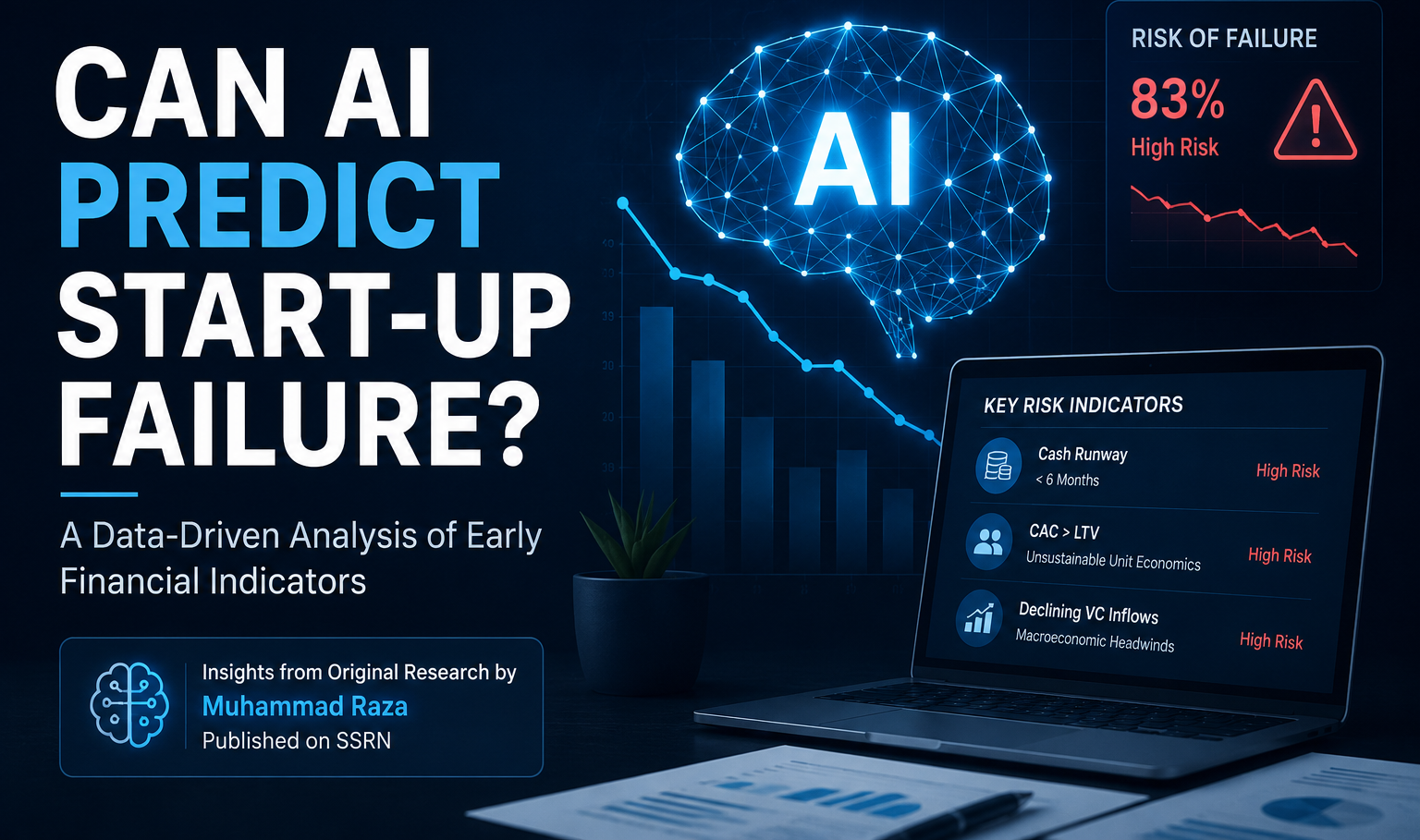
Among the algorithms tested, the XGBoost (Extreme Gradient Boosting) model emerged as the superior predictive engine. It achieved an impressive 83% accuracy rate and an Area Under the Curve (AUC) of 0.88, demonstrating a high degree of reliability in distinguishing between start-ups that will survive and those headed toward liquidation or shutdown.
Key Predictive Indicators: What Signals Start-up Failure?
Machine learning models do not rely on guesswork; they parse through thousands of variables to isolate the most statistically significant correlations. According to the study, three primary financial and operational red flags are most heavily weighted when predicting early-stage failure:
1. A Cash Runway Under Six Months
Unsurprisingly, liquidity remains the single most critical determinant of short-term survival. Start-ups operating with a cash runway of fewer than six months face an exponentially higher risk of shutdown, as they lack the buffer required to pivot business models or secure bridge funding during market downturns.
2. Unsustainable Unit Economics (CAC Exceeding LTV)
A fundamental flaw in many failed ventures is an unbalanced relationship between customer acquisition cost (CAC) and customer lifetime value (LTV). When the capital required to acquire a customer consistently exceeds the total revenue that customer generates over their lifecycle, the business model is mathematically unsustainable.
3. Macroeconomic Headwinds and Declining Venture Capital Inflows
Micro-level financial health does not exist in a vacuum. The study highlights that operating within a specific technology sector experiencing declining sector-wide venture capital inflows severely diminishes a start-up’s probability of survival, regardless of internal operational efficiency.
What Does Not Matter? The Paradox of Early Profitability
One of the most intriguing conclusions of the research challenges conventional corporate finance wisdom: traditional profitability metrics showed negligible predictive power during a start-up’s earliest stages.
During the first three years of operation, metrics like immediate net income or traditional accounting profits are largely overshadowed by cash burn velocity, top-line growth efficiency, and macro liquidity trends. Early-stage technology companies are frequently valued and evaluated based on growth and market capture rather than near-term profitability, making cash flow dynamics far more critical than traditional bottom-line reporting.
Practical Implications for Founders and Investors
The integration of artificial intelligence and machine learning into financial risk assessment offers profound practical benefits for key stakeholders in the financial ecosystem:
- For Start-up Founders: Automated early-warning systems serve as an objective corporate health audit. Founders can utilize these predictive markers to proactively manage their burn rates, optimize unit economics, and adjust strategy before liquid capital completely dries up.
- For Venture Capitalists and Investors: Relying solely on founder pitches and vanity growth metrics is no longer sufficient. Institutional investors can integrate machine learning algorithms into their due diligence pipelines to objectively screen prospective deals and continuously monitor portfolio risk exposure.
Conclusion
The intersection of artificial intelligence and venture finance is rapidly evolving. As demonstrated by Muhammad Raza’s research paper on SSRN, machine learning models like XGBoost provide a reliable framework for forecasting start-up distress well in advance. By focusing on critical operational indicators such as cash runway and unit economics rather than early accounting profits, stakeholders can better navigate the volatile landscape of modern entrepreneurship.
To read the complete research paper, download the document directly from SSRN.