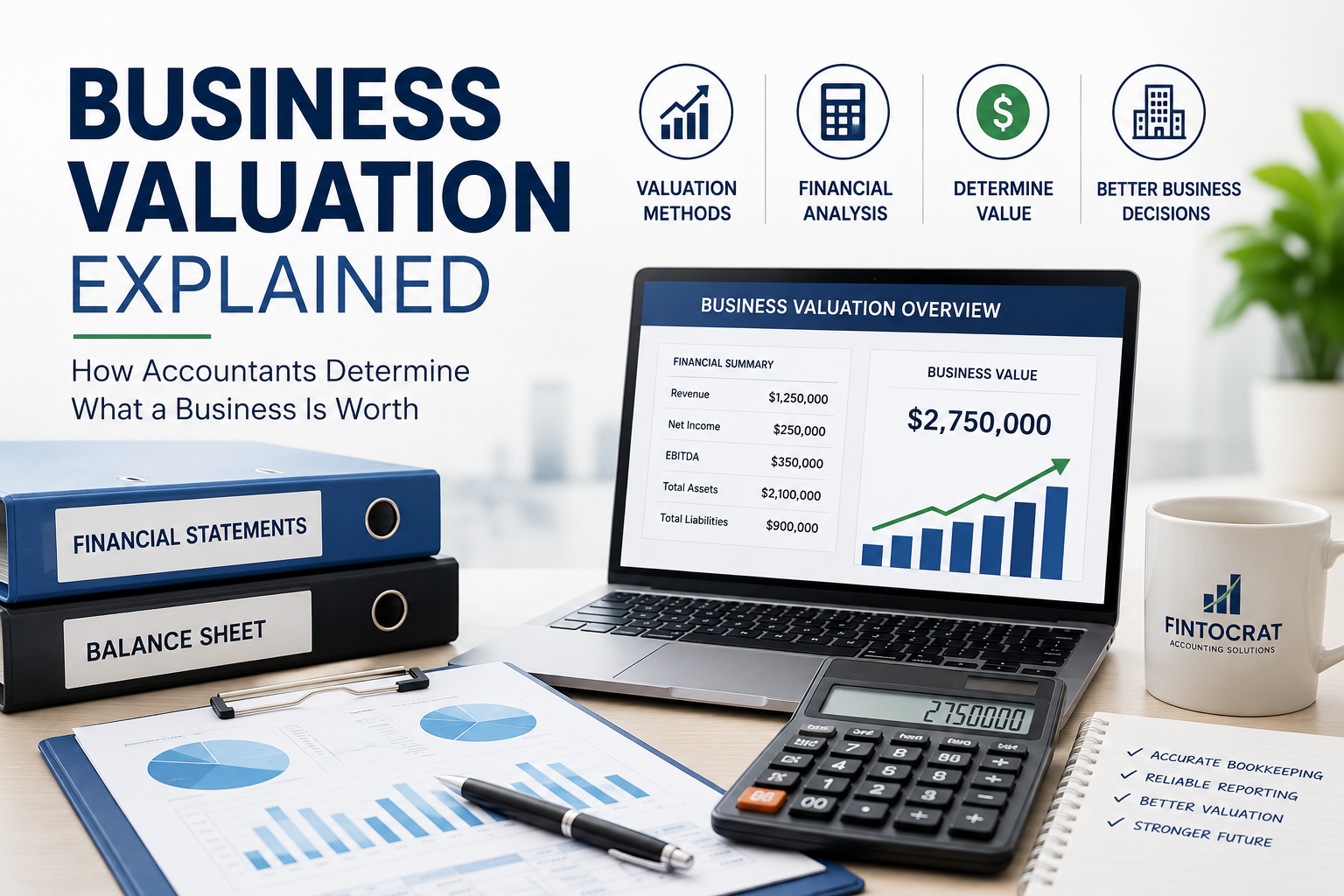
Business valuation is one of the most important concepts in finance, accounting, investing, and entrepreneurship. Whether you’re planning to sell your business, attract investors, merge with another company, raise capital, or simply understand what your company is worth, knowing how business valuation works is essential.
A well-executed business valuation goes far beyond estimating revenue or profits. It considers assets, liabilities, cash flow, growth potential, industry trends, market conditions, and risk factors to determine the fair economic value of a business.
In this comprehensive guide, you’ll learn what business valuation is, why it matters, the most common valuation methods, key formulas, factors affecting valuation, and practical examples.
What Is Business Valuation?
Business valuation is the process of determining the economic value of a company.
It estimates how much a business is worth at a specific point in time based on financial performance, assets, future earning potential, and market conditions.
Valuation helps owners, investors, lenders, buyers, and financial advisors make informed decisions backed by financial analysis rather than assumptions.
Why Business Valuation Is Important
Business valuation is useful in many situations.
Selling a Business
A realistic valuation helps sellers negotiate confidently while ensuring buyers pay a fair price.
Raising Investment
Investors need to know how much equity they’re receiving in exchange for their investment.
Mergers and Acquisitions
Companies use valuations to determine fair acquisition prices.
Succession Planning
Family businesses often require valuations before transferring ownership.
Tax Planning
Tax authorities may require valuations for estate planning, gifts, or corporate restructuring.
Financial Reporting
Certain accounting standards require businesses to measure fair values for acquisitions and intangible assets.
What Determines a Business’s Value?
Many factors influence business value.
Financial Performance
- Revenue
- Net profit
- EBITDA
- Cash flow
- Profit margins
Assets
Examples include:
- Buildings
- Equipment
- Inventory
- Investments
- Cash
Liabilities
Outstanding debts reduce overall business value.
Examples include:
- Loans
- Creditors
- Tax liabilities
Industry Growth
Companies operating in rapidly growing industries often receive higher valuations.
Customer Base
Businesses with loyal customers and recurring revenue generally command higher prices.
Competitive Advantage
Examples include:
- Strong brand recognition
- Proprietary technology
- Patents
- Exclusive contracts
Management Team
Experienced leadership reduces operational risk.
Market Conditions
Economic growth, inflation, and interest rates all influence valuations.
Common Business Valuation Methods
Different valuation methods produce different results depending on the company and purpose.
The best analysts usually compare several methods.
1. Asset-Based Valuation
This approach values a company based on what it owns minus what it owes.
Formula
Business Value = Total Assets − Total Liabilities
Example
Assets
- Cash = $150,000
- Equipment = $500,000
- Inventory = $250,000
Total Assets
= $900,000
Liabilities
= $300,000
Business Value
= $900,000 − $300,000
= $600,000
Best For
- Manufacturing businesses
- Asset-heavy companies
- Liquidation scenarios
2. Income-Based Valuation
This method focuses on future earnings rather than current assets.
The most common approach is the Discounted Cash Flow (DCF) model.
Future cash flows are estimated and discounted back to present value.
Advantages
- Forward-looking
- Highly analytical
- Widely used by investors
Disadvantages
- Sensitive to assumptions
- Requires financial forecasting
3. Market-Based Valuation
This approach compares similar businesses that have recently been sold.
It’s similar to valuing houses using nearby sales.
Common valuation multiples include:
- Price-to-Earnings (P/E)
- EV/EBITDA
- Price-to-Sales
Example
Comparable businesses sell for:
6 × EBITDA
Your business EBITDA:
$400,000
Business Value
= 6 × $400,000
= $2.4 million
4. Earnings Multiplier Method
Rather than using current profits alone, future earning potential is emphasized.
Example:
Annual Earnings
$500,000
Industry Multiple
7
Business Value
= $500,000 × 7
= $3.5 million
5. EBITDA Multiple Method
EBITDA stands for:
Earnings Before Interest, Taxes, Depreciation, and Amortization
It removes financing and accounting differences to compare companies fairly.
Example:
EBITDA
$800,000
Industry Multiple
8
Business Value
= $6.4 million
6. Revenue Multiple Method
Some startups are valued using revenue instead of profits.
Example
Revenue
$2 million
Industry Multiple
3
Business Value
= $6 million
This method is common in SaaS and technology companies.
Understanding Enterprise Value
Enterprise Value (EV) measures the value of the entire business.
Formula
Enterprise Value = Market Value of Equity + Debt − Cash
Unlike market capitalization, enterprise value considers debt obligations.
Equity Value vs Enterprise Value
| Equity Value | Enterprise Value |
| Value belonging to shareholders | Value of the entire business |
| Excludes debt | Includes debt |
| Used by shareholders | Used by buyers and investors |
Factors That Increase Business Value
Businesses generally receive higher valuations when they have:
- Consistent revenue growth
- Strong profit margins
- Positive cash flow
- Low customer concentration
- Recurring subscription income
- Strong management
- Scalable operations
- Reliable financial statements
- Competitive advantage
- High customer retention
Factors That Reduce Business Value
Valuations decrease when businesses have:
- Declining sales
- Poor bookkeeping
- High debt
- Customer dependence
- Legal disputes
- Weak cash flow
- Outdated technology
- Poor management
- Economic uncertainty
Business Valuation Example
Example: Manufacturing Company Valuation
Imagine a manufacturing company with the following financials:
| Metric | Amount |
| Annual Revenue | $8 million |
| EBITDA | $1.5 million |
| Industry Multiple | 7× |
Business Value
$1.5 million×7=$10.5 million
How Professionals Value Businesses
Professional valuators usually follow these steps:
- Gather financial statements.
- Analyze historical performance.
- Normalize earnings.
- Forecast future cash flows.
- Choose appropriate valuation methods.
- Compare industry benchmarks.
- Apply valuation multiples.
- Prepare a valuation report.
Common Valuation Mistakes
Avoid these errors:
- Using unrealistic growth assumptions
- Ignoring market conditions
- Overvaluing intangible assets
- Forgetting liabilities
- Using outdated financial data
- Comparing with unrelated companies
- Relying on only one valuation method
Business Valuation and Accounting
Accurate accounting is the foundation of reliable business valuation.
Proper bookkeeping helps ensure:
- Accurate financial statements
- Reliable cash flow analysis
- Correct asset valuation
- Better forecasting
- Increased investor confidence
Without quality accounting records, even sophisticated valuation models become unreliable.
Frequently Asked Questions
What is the best business valuation method?
There is no single best method. Professionals often combine asset-based, income-based, and market-based approaches to arrive at a balanced valuation.
Who performs business valuations?
Certified valuation professionals, accountants, investment bankers, financial analysts, and business consultants commonly perform valuations.
Why do startups often have high valuations despite low profits?
Investors may value startups based on future growth potential, market opportunity, intellectual property, and recurring revenue rather than current profitability.
How often should a business be valued?
Many businesses obtain a valuation annually or whenever a major event occurs, such as fundraising, acquisitions, ownership changes, or succession planning.
Final Thoughts
Business valuation is both an art and a science. While formulas and financial models provide structure, professional judgment is essential when evaluating future growth, industry trends, competitive positioning, and risk.
Whether you’re an entrepreneur preparing for investment, a business owner considering a sale, or a finance student building your knowledge, understanding valuation methods will help you make smarter financial decisions. Strong accounting records, realistic forecasts, and the use of multiple valuation approaches lead to the most credible and actionable valuations.
More Articles
- The Network Effect Explained: How Businesses Become More Valuable as They Grow
- How to Read Your Profit and Loss Statement
- Bookkeeping vs Accounting: What’s the Difference?
- Cash vs Accrual Accounting Explained: Which Method Is Right for Your Business?
- How to Improve Business Cash Flow: Proven Strategies for Sustainable Growth
- The Complete Guide to Accounting Ratios: Types, Formulas, Interpretation, and Real-World Examples
Further Reading
- Investopedia – Business Valuation: https://www.investopedia.com/
- Corporate Finance Institute – Valuation Resources: https://corporatefinanceinstitute.com/resources/valuation/
- IFRS Foundation – Financial Reporting Standards: https://www.ifrs.org/
- International Valuation Standards Council (IVSC): https://www.ivsc.org/