
Some of the world’s most valuable companies share a common advantage that extends far beyond innovative products or substantial marketing budgets. Companies like Apple, Visa, Mastercard, Amazon, LinkedIn, Uber, Airbnb, WhatsApp, and Microsoft have built businesses that become more valuable every time a new customer joins.
This powerful phenomenon is known as the network effect.
Unlike traditional businesses that rely primarily on increasing production or reducing costs to grow, network-effect businesses gain strength from their users. Every new participant enhances the value of the network for everyone else, creating a cycle of growth that is difficult for competitors to replicate.
Understanding network effects is essential for entrepreneurs, investors, business leaders, and anyone interested in modern business strategy. Whether you’re building a startup, evaluating investment opportunities, or simply curious about how the world’s largest companies dominate their industries, the network effect is one of the most important concepts to understand.
In this comprehensive guide, you’ll learn what the network effect is, how it works, the different types of network effects, real-world examples, and why it creates one of the strongest competitive advantages in business.
What Is the Network Effect?
A network effect occurs when the value of a product or service increases as more people use it.
Instead of growth simply adding more customers, each additional user makes the product or service more useful for everyone already using it.
For example, imagine you’re the only person in the world with a telephone. It has almost no value because there is no one to call. Add a second user, and suddenly both people can communicate. As millions more people join the telephone network, its usefulness grows dramatically.
The same principle applies to digital platforms today.
Every new buyer on an online marketplace attracts more sellers. More sellers provide greater product variety, which attracts even more buyers. This self-reinforcing cycle drives continuous growth and strengthens the platform over time.
Why Network Effects Matter
Network effects are among the most powerful drivers of long-term business success because they create a cycle of increasing value.
As a network grows:
- Customers receive more value.
- Businesses attract more users.
- Revenue opportunities increase.
- Customer retention improves.
- Competitive barriers become stronger.
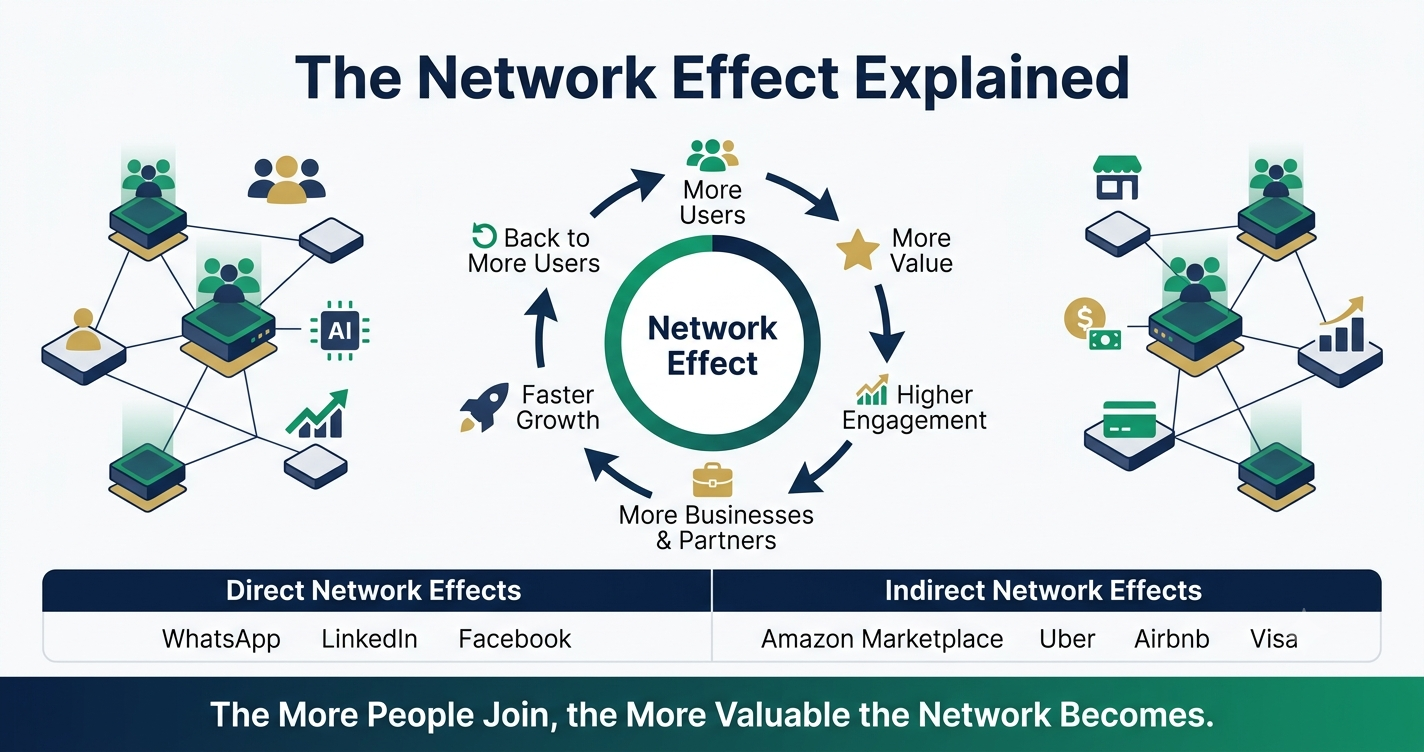
This creates a powerful feedback loop:
More Users → More Value → More Users → Stronger Business
Companies with strong network effects often enjoy sustainable growth because competitors find it difficult to convince users to switch to a smaller, less valuable network.
How the Network Effect Works
The network effect is built on a simple principle:
Each new participant contributes value to the existing network.
Imagine a freelance marketplace.
Initially:
- 10 freelancers
- 5 clients
The marketplace has limited opportunities.
Now imagine the platform grows to:
- 100,000 freelancers
- 80,000 clients
Clients have a much larger talent pool.
Freelancers have more job opportunities.
Higher activity attracts even more users.
The platform becomes significantly more valuable without changing its core service.
This is the network effect in action.
Characteristics of Strong Network Effects
Businesses with powerful network effects typically share several characteristics.
Increasing Value
The product becomes more useful as the user base grows.
LinkedIn becomes more valuable as more professionals join because users gain access to a larger professional network.
Self-Reinforcing Growth
Existing users naturally attract new users.
Satisfied customers invite friends, colleagues, or business partners, expanding the network organically.
High Switching Costs
Once users invest time, data, contacts, or reputation into a platform, moving to a competing platform becomes increasingly difficult.
This strengthens customer loyalty.
Competitive Advantage
Network-effect businesses become harder to compete against as they scale.
Even competitors with superior technology often struggle because they lack the same user base.
Types of Network Effects
Not all network effects are the same. Understanding the different types helps explain why certain businesses dominate their industries.
1. Direct Network Effects
Direct network effects occur when each additional user directly increases value for every other user.
Examples
- Telephone networks
- Telegram
The more people who join, the more useful these platforms become.
A messaging app with only five users offers little value.
One with two billion users becomes indispensable.
2. Indirect Network Effects
Indirect network effects occur when growth on one side of a platform increases value for another group of users.
Example: Amazon Marketplace
More sellers create:
- Greater product variety
- Better pricing
- Increased competition
This attracts more buyers.
More buyers encourage additional sellers to join.
Both sides strengthen one another.
3. Two-Sided Network Effects
Two-sided platforms connect two different groups of users.
Each group depends on the other.
Examples include:
- Uber (Drivers ↔ Riders)
- Airbnb (Hosts ↔ Guests)
- Fiverr (Freelancers ↔ Clients)
- Upwork (Businesses ↔ Freelancers)
Growth on one side creates opportunities for the other side.
4. Data Network Effects
Some companies improve their products as they collect more data.
Additional users generate:
- Better recommendations
- Smarter algorithms
- Improved personalization
- Higher accuracy
Examples include:
- Google Search
- Spotify
- Netflix
- TikTok
As these platforms gather more user interactions, they continuously refine the experience, attracting even more users.
5. Local Network Effects
Some businesses experience network effects within specific geographic regions rather than globally.
Ride-sharing platforms are excellent examples.
Uber is valuable only when enough drivers and riders exist within the same city.
Strong local density creates faster pickups and shorter wait times.
Positive vs. Negative Network Effects
Network effects are not always beneficial.
Positive Network Effects
Positive network effects occur when every new participant improves the experience for everyone else.
Examples include:
- Visa
- Airbnb
Growth increases value.
Negative Network Effects
Sometimes excessive growth reduces value.
Examples include:
- Social media overcrowding
- Traffic congestion
- Spam messages
- Marketplace saturation
If quality declines as the network expands, users may begin leaving the platform.
Successful businesses continuously manage growth to preserve user experience.
The Network Effect Flywheel
Many successful companies benefit from a self-sustaining growth cycle:
- Better product attracts users.
- More users increase platform value.
- Increased value attracts businesses and partners.
- More businesses improve customer choice.
- Improved experience attracts even more users.
Over time, this flywheel becomes increasingly difficult for competitors to interrupt.
Real-World Examples of Network Effects
Visa
Visa doesn’t issue credit cards or lend money. Instead, it operates one of the world’s largest payment networks.
As more merchants accept Visa cards, more consumers choose Visa.
As more consumers carry Visa cards, additional merchants begin accepting Visa.
This reinforcing cycle has helped Visa become one of the most valuable financial networks in the world.
Mastercard
Mastercard follows the same model.
Banks, merchants, consumers, and payment processors all benefit from participating in the same network.
Every new participant strengthens the ecosystem.
LinkedIn becomes increasingly valuable as professionals, recruiters, businesses, and job seekers join.
Recruiters gain access to more talent.
Professionals discover more career opportunities.
Businesses expand their reach.
Every new member improves the network for everyone else.
Amazon Marketplace
Amazon Marketplace is one of the strongest examples of indirect network effects.
As more sellers join the platform:
- Customers gain access to a wider selection of products.
- Increased competition often leads to better prices.
- Faster fulfillment and improved availability enhance the customer experience.
As more customers shop on Amazon, the platform becomes increasingly attractive for businesses looking to reach a large audience. This continuous cycle strengthens Amazon’s position as one of the world’s largest online marketplaces.
Uber
Uber operates a classic two-sided marketplace.
More drivers result in:
- Shorter wait times
- Better geographic coverage
- More ride availability
This attracts more riders.
More riders create greater earning opportunities, encouraging additional drivers to join.
Both sides reinforce one another, creating a powerful network effect.
Airbnb
Airbnb connects millions of travelers with property owners worldwide.
More hosts mean:
- Greater accommodation choices
- More locations
- Increased price competition
This attracts more travelers.
As traveler demand grows, additional property owners list their homes.
The marketplace becomes increasingly valuable for both groups.
Apple
Apple’s ecosystem demonstrates multiple network effects.
A larger customer base encourages developers to create more apps for the App Store.
More apps make Apple devices more useful.
Higher customer demand encourages accessory manufacturers, software companies, and service providers to invest in the Apple ecosystem.
Every participant strengthens the platform.
Microsoft Windows
Windows became the dominant desktop operating system because developers built software specifically for it.
More software encouraged more consumers to purchase Windows computers.
A larger user base attracted even more developers.
This feedback loop helped Microsoft maintain market leadership for decades.
A messaging platform has little value without people to communicate with.
As more friends, family members, and businesses join WhatsApp, the service becomes increasingly indispensable.
This is one of the clearest examples of a direct network effect.
Shopify
Shopify combines several network effects.
As more merchants join:
- Developers build more applications.
- Designers create more themes.
- Marketing agencies offer Shopify expertise.
- Payment providers integrate with the platform.
The expanding ecosystem makes Shopify increasingly attractive to new businesses.
Network Effects vs. Economies of Scale
Although they are often mentioned together, network effects and economies of scale are different concepts.
| Network Effects | Economies of Scale |
|---|---|
| Value increases as more users join | Costs decrease as production increases |
| Driven by user participation | Driven by operational efficiency |
| Common in digital platforms | Common in manufacturing and logistics |
| Strengthens customer value | Improves business profitability |
For example:
A social media platform becomes more valuable because millions of people use it.
A manufacturing company becomes more profitable because producing additional units reduces the average cost per product.
The two concepts can exist together, but they are not the same.
Network Effects vs. Competitive Moats
A competitive moat is any advantage that protects a business from competitors.
Network effects are one type of moat, but not the only one.
Other competitive moats include:
- Strong brands
- Patents
- Intellectual property
- Cost advantages
- Exclusive distribution
- Regulatory licenses
Companies like Visa, Mastercard, LinkedIn, and Airbnb benefit from network effects while also enjoying other competitive advantages.
How Businesses Build Network Effects
Creating a network effect doesn’t happen overnight.
Successful businesses typically follow several stages.
Start with a Clear Value Proposition
A platform must solve a genuine problem before network effects can develop.
Users join because the product provides immediate value—not because it already has millions of users.
Focus on One Market
Many successful companies began by dominating a small niche.
Facebook originally served only university students.
Uber launched in a single city.
Airbnb started by targeting conference attendees needing accommodation.
Strong local adoption creates momentum before expanding.
Reduce Friction
Joining a platform should be simple.
Successful businesses remove barriers by offering:
- Easy registration
- Free trials
- Secure payments
- Intuitive interfaces
- Fast onboarding
Lower friction accelerates user growth.
Encourage Sharing
Many network businesses grow through referrals.
Examples include:
- Referral bonuses
- Invite-a-friend programs
- Collaboration features
- Social sharing
Every invitation introduces new users to the network.
Continuously Improve the Experience
As networks grow, maintaining quality becomes essential.
Businesses invest in:
- Customer support
- Trust and safety
- Fraud prevention
- Personalization
- Better recommendations
A high-quality experience keeps users engaged and encourages continued growth.
Financial Metrics That Reveal Strong Network Effects
Investors often evaluate network businesses using specific performance metrics.
Customer Acquisition Cost (CAC)
Measures how much it costs to acquire each new customer.
Businesses with strong network effects often experience declining acquisition costs because existing users help attract new ones.
Customer Lifetime Value (LTV)
Measures the total revenue expected from a customer over their relationship with the business.
High LTV often reflects strong customer loyalty and engagement.
Retention Rate
A high retention rate indicates customers continue using the platform over time.
Strong network effects generally improve retention because leaving the platform means losing valuable connections.
Engagement
Metrics such as:
- Daily Active Users (DAU)
- Monthly Active Users (MAU)
- Session duration
- Transactions per user
help measure the health of a network.
Growing engagement often strengthens network effects.
Gross Merchandise Value (GMV)
Marketplace businesses frequently monitor GMV—the total value of transactions completed through the platform.
Increasing GMV usually indicates a stronger marketplace.
Challenges of Network Effects
Despite their advantages, network businesses face several challenges.
Reaching Critical Mass
Many platforms fail because they cannot attract enough users to make the service valuable.
Without sufficient participants, the network effect never begins.
Maintaining Trust
Fraud, spam, fake accounts, or poor-quality listings can reduce user confidence.
Successful platforms invest heavily in moderation and verification.
Balancing Supply and Demand
Marketplace businesses must grow both sides of the platform together.
Too many sellers without buyers—or vice versa—creates a poor user experience.
Regulation
Large network businesses often face increased regulatory scrutiny related to competition, privacy, and consumer protection.
Common Myths About Network Effects
Myth 1: Every Successful Business Has Network Effects
Many profitable companies succeed through excellent products, strong brands, or operational efficiency rather than network effects.
Myth 2: Growth Automatically Creates Network Effects
Simply gaining customers doesn’t create a network effect.
New users must increase the value of the product for existing users.
Myth 3: Network Effects Guarantee Success
Businesses still need innovation, excellent customer service, and effective execution to remain competitive.
The Future of Network Effects
Artificial intelligence, fintech, and digital platforms are creating new forms of network effects.
AI systems improve as they learn from larger datasets.
Payment platforms become stronger as more merchants and consumers participate.
Business software increasingly benefits from developer ecosystems and third-party integrations.
As the global economy becomes more connected, network effects will continue shaping the world’s most valuable companies.
Frequently Asked Questions
What is the simplest definition of a network effect?
A network effect occurs when a product or service becomes more valuable as more people use it.
Which companies have the strongest network effects?
Examples include Visa, Mastercard, LinkedIn, WhatsApp, Apple, Microsoft, Amazon Marketplace, Uber, Airbnb, and Shopify.
Are network effects only found in technology companies?
No. Payment networks, marketplaces, professional associations, and many financial services businesses also benefit from network effects.
Can small businesses create network effects?
Yes. Communities, referral programs, local marketplaces, and customer ecosystems can all generate network effects on a smaller scale.
Final Thoughts
The network effect is one of the most powerful forces in modern business. It enables companies to create products and platforms that become increasingly valuable as more users participate, generating sustainable growth and lasting competitive advantages.
Whether you’re building a startup, evaluating investments, or managing an established business, understanding network effects provides valuable insight into why certain companies dominate their industries. By recognizing the different types of network effects, learning how they develop, and understanding the metrics that measure their strength, you can make more informed strategic and financial decisions.
In today’s digital economy, businesses that successfully harness network effects are often the ones that shape industries, redefine customer expectations, and create enduring value for users, shareholders, and society.
More Articles
- How to Read a Balance Sheet: A Small Business Guide
- How to Read Your Profit and Loss Statement
- Bookkeeping vs Accounting: What’s the Difference?
- Cash vs Accrual Accounting Explained: Which Method Is Right for Your Business?
- How to Improve Business Cash Flow: Proven Strategies for Sustainable Growth
- The Complete Guide to Accounting Ratios: Types, Formulas, Interpretation, and Real-World Examples
Recommended Resources
- Harvard Business Review – The Power of Network Effects: https://hbr.org
- Investopedia – Network Effect Definition: https://www.investopedia.com
- NFX – Network Effects Knowledge Base: https://www.nfx.com