A Profit and Loss (P&L) Statement, also known as an Income Statement, is one of the most important financial reports every business owner should understand. Whether you’re a startup founder, freelancer, e-commerce seller, or small business owner, your profit and loss statement reveals whether your business is making money, where you’re spending it, and how profitable your operations truly are.
Yet, many business owners only look at the bottom line—or worse, ignore their P&L statement until tax season. Doing so means missing valuable insights that can help improve cash flow, reduce unnecessary expenses, and make better strategic decisions.
In this comprehensive guide, you’ll learn how to read a profit and loss statement, understand each section, identify key financial metrics, and use the information to grow a healthier, more profitable business.
What Is a Profit and Loss Statement?
A Profit and Loss Statement (P&L) is a financial report that summarizes your revenue, expenses, and profits over a specific period, such as a month, quarter, or year.
Its primary purpose is to show whether your business made a profit or incurred a loss during that period.
A typical profit and loss statement answers questions like:
- How much revenue did my business generate?
- What did it cost to earn that revenue?
- Where is my money being spent?
- Is my business profitable?
- Are profits improving over time?
Together with your Balance Sheet and Cash Flow Statement, the P&L statement provides a complete picture of your business’s financial health.
Why Your Profit and Loss Statement Matters
Your P&L statement isn’t just for accountants—it’s one of the most valuable decision-making tools for business owners.
Regularly reviewing your income statement helps you:
- Measure profitability
- Monitor business performance
- Identify unnecessary expenses
- Improve pricing strategies
- Plan future budgets
- Prepare for tax season
- Secure loans or investment
- Make informed business decisions
Businesses that review financial reports monthly are generally better equipped to identify trends and respond to changing market conditions.
The Main Sections of a Profit and Loss Statement
Understanding each section makes it much easier to interpret your financial performance.
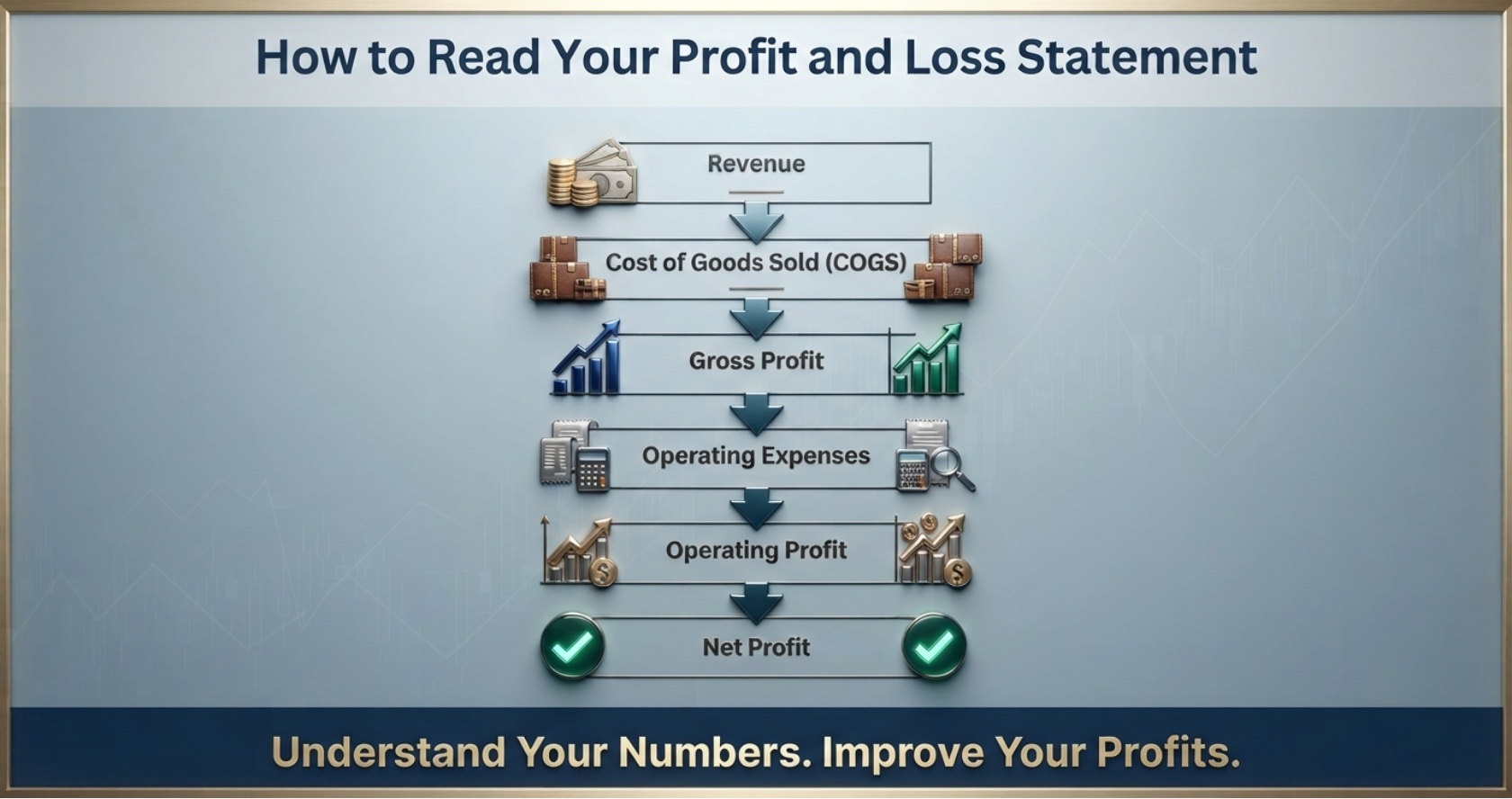
1. Revenue (Sales)
Revenue is the total income generated from selling products or services before any expenses are deducted.
Examples include:
- Product sales
- Service income
- Subscription revenue
- Consulting fees
Higher revenue is generally positive, but it doesn’t necessarily mean your business is profitable.
2. Cost of Goods Sold (COGS)
Cost of Goods Sold represents the direct costs of producing your products or delivering your services.
Examples include:
- Inventory
- Raw materials
- Manufacturing costs
- Direct labor
- Shipping related to production
Subtracting COGS from revenue gives you your Gross Profit.
3. Gross Profit
Formula:
Revenue – Cost of Goods Sold = Gross Profit
Gross profit measures how efficiently your business produces or delivers its products and services.
Example
Revenue: $120,000
COGS: $45,000
Gross Profit: $75,000
A healthy gross profit allows your business to cover operating expenses and generate net profit.
4. Operating Expenses
Operating expenses are the costs required to run your business.
Common examples include:
- Rent
- Salaries
- Marketing
- Utilities
- Software subscriptions
- Insurance
- Office supplies
- Professional services
Unlike COGS, these expenses aren’t directly tied to producing products or services.
5. Operating Profit
Operating Profit (sometimes called Operating Income) shows how profitable your business operations are before taxes and financing costs.
Formula:
Gross Profit – Operating Expenses = Operating Profit
This metric provides a clearer view of how efficiently your business operates.
6. Other Income and Expenses
This section includes items not related to daily operations, such as:
- Interest income
- Interest expense
- Investment gains
- Asset sales
- Foreign exchange gains or losses
These items can affect your overall profitability.
7. Net Profit
Net Profit is often called the bottom line because it appears at the bottom of your P&L statement.
Formula:
Revenue − Total Expenses = Net Profit
If the result is positive, your business made a profit.
If it’s negative, your business incurred a loss.
Net profit is one of the most closely watched indicators of business success.
Sample Profit and Loss Statement
| Item | Amount |
|---|---|
| Revenue | $150,000 |
| Cost of Goods Sold | $60,000 |
| Gross Profit | $90,000 |
| Operating Expenses | $55,000 |
| Operating Profit | $35,000 |
| Other Expenses | $3,000 |
| Net Profit | $32,000 |
From this statement, you can quickly determine:
- The business is profitable.
- Gross profit is healthy.
- Operating expenses are controlled.
- Net profit remains positive after all expenses.
How to Analyze Your Profit and Loss Statement
Don’t just read the numbers—look for patterns and opportunities.
Compare Revenue Trends
Ask yourself:
- Is revenue increasing each month?
- Which products generate the most income?
- Are sales becoming seasonal?
Growing revenue generally indicates increasing demand.
Monitor Gross Profit
If revenue rises but gross profit falls, your production costs may be increasing.
This could indicate:
- Rising supplier prices
- Inefficient production
- Poor pricing strategy
Review Operating Expenses
Look for expenses that have increased unexpectedly.
Examples include:
- Advertising
- Software subscriptions
- Payroll
- Office expenses
Reducing unnecessary costs can significantly improve profitability.
Watch Net Profit
Your ultimate goal isn’t simply increasing sales—it’s increasing profits.
Sometimes reducing expenses has a greater impact than generating additional revenue.
Key Profitability Metrics
Your P&L statement helps calculate several important financial ratios.
Gross Profit Margin
Formula
Gross Profit ÷ Revenue × 100
This measures how efficiently your business generates profit after production costs.
Net Profit Margin
Formula
Net Profit ÷ Revenue × 100
This shows how much profit remains from every dollar of revenue.
Higher margins usually indicate stronger financial performance.
Operating Margin
Operating Margin measures profitability before taxes and financing costs.
It’s an excellent indicator of operational efficiency.
Common Mistakes When Reading a Profit and Loss Statement
Focusing Only on Revenue
High sales don’t always mean high profits.
Ignoring Expenses
Even small recurring expenses can significantly reduce profitability over time.
Looking Only at the Bottom Line
Review every section of the statement—not just net profit.
Comparing One Month Only
Always compare multiple months or years to identify meaningful trends.
Not Reviewing Reports Regularly
Monthly reviews help detect problems before they become serious.
How Often Should You Review Your Profit and Loss Statement?
Most businesses should review their P&L:
- Monthly
- Quarterly
- Annually
Monthly reviews provide the best opportunity to identify trends and make timely adjustments.
Using Your Profit and Loss Statement to Grow Your Business
A well-maintained P&L statement helps you:
- Improve pricing
- Reduce unnecessary expenses
- Increase profitability
- Set realistic budgets
- Forecast future growth
- Prepare for financing
- Support strategic planning
- Make confident business decisions
Successful businesses don’t just prepare financial reports—they use them to guide every major decision.
Frequently Asked Questions
Is a Profit and Loss Statement the same as an Income Statement?
Yes. Both terms refer to the same financial report.
What’s the difference between profit and cash?
Profit measures revenue minus expenses, while cash refers to the actual money available in your business.
Why is my business profitable but low on cash?
This often happens due to unpaid customer invoices, inventory purchases, or loan repayments. Your Cash Flow Statement provides additional insight.
Who should review a Profit and Loss Statement?
Every business owner should review their P&L regularly, regardless of company size.
Final Thoughts
Your profit and loss statement is much more than a financial report—it’s a roadmap to understanding your business’s performance. By learning how to interpret revenue, expenses, gross profit, operating profit, and net profit, you can identify opportunities, control costs, and make smarter decisions that drive sustainable growth.
Don’t wait until year-end or tax season to review your numbers. Make it a habit to analyze your P&L statement every month. Combined with accurate bookkeeping and professional accounting support, it can become one of the most valuable tools for improving profitability and achieving long-term business success.
Related Articles
- Bookkeeping vs Accounting: What’s the Difference?
- Cash vs Accrual Accounting Explained
- How to Improve Business Cash Flow
- How to Use Investment Appraisal Techniques for Better Management Decisions
- Top 10 Accounting Software Tools for Small Businesses
Recommended Resources
- IRS – Business Recordkeeping: https://www.irs.gov/businesses/small-businesses-self-employed/recordkeeping
- SBA – Manage Your Business Finances: https://www.sba.gov/business-guide/manage-your-business/manage-your-finances
- QuickBooks Resource Center: https://quickbooks.intuit.com
- Xero Learning Hub: https://www.xero.com
- SCORE Business Resources: https://www.score.org