Looking at your balance sheet and seeing a wall of numbers? You aren’t alone. Many business owners focus entirely on sales and profit, but your balance sheet is the most powerful tool you have to avoid cash flow disasters and spot hidden risks.
The best part? You don’t need an accounting degree to understand it. In this guide, we’ll demystify your balance sheet by breaking down assets, liabilities, and equity into plain English. By the time you’re finished, you won’t just be ‘reading’ a report; you’ll be using your financials to make smarter, more confident decisions for your business’s future.
What Is a Balance Sheet?
A balance sheet is a financial statement that shows what your business owns (assets), owes (liabilities), and the owner’s investment (equity) at a specific point in time.
Unlike a Profit and Loss Statement, which measures performance over a period, a balance sheet provides a snapshot of your business’s financial position on a particular date.
Business owners, investors, lenders, and accountants use balance sheets to assess financial stability and make informed decisions.
Why Is a Balance Sheet Important?
Your balance sheet helps you answer important questions, including:
- How much cash does my business have?
- What assets does my business own?
- How much debt do I owe?
- Is my business financially stable?
- Can I afford to expand?
- Will lenders consider my business financially healthy?
Regularly reviewing your balance sheet helps identify strengths, weaknesses, and opportunities for growth.
The Balance Sheet Formula
Every balance sheet is built on one simple accounting equation:
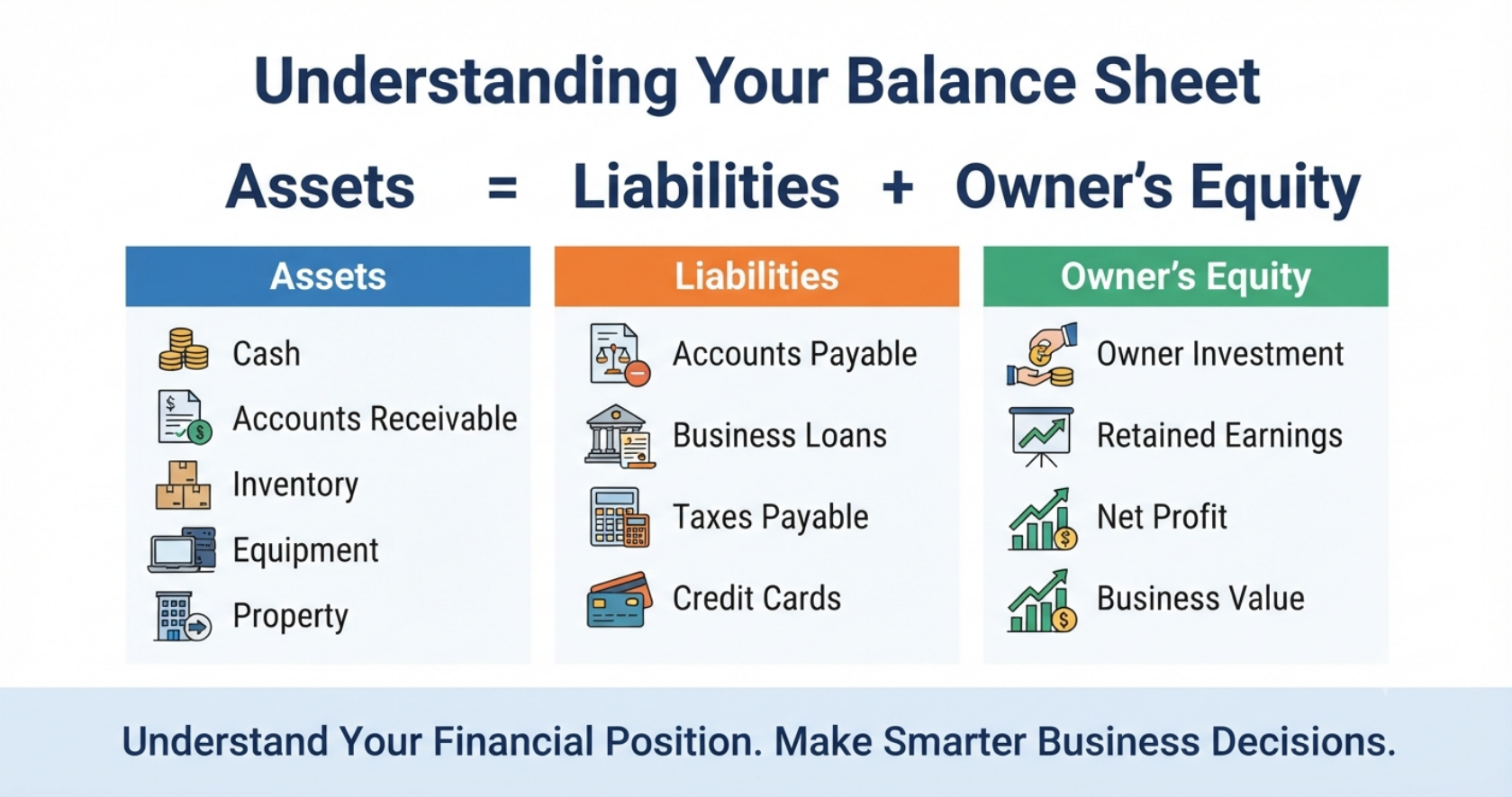
Assets = Liabilities + Owner’s Equity
This equation must always remain balanced.
For example:
Assets: $250,000
Liabilities: $90,000
Owner’s Equity: $160,000
$250,000 = $90,000 + $160,000
If the equation doesn’t balance, there’s likely an accounting error that should be investigated.
The Three Main Sections of a Balance Sheet
1. Assets
Assets are everything your business owns that has financial value.
Assets help generate income and support business operations.
Current Assets
Current assets are expected to be converted into cash or used within one year.
Examples include:
- Cash and cash equivalents
- Accounts receivable
- Inventory
- Prepaid expenses
- Short-term investments
Non-Current Assets
These assets provide long-term value.
Examples include:
- Property
- Buildings
- Machinery
- Vehicles
- Furniture
- Equipment
- Patents
- Trademarks
- Goodwill
Growing businesses often invest in long-term assets to support future expansion.
2. Liabilities
Liabilities represent money your business owes to others.
Current Liabilities
These obligations are generally due within one year.
Examples include:
- Accounts payable
- Payroll liabilities
- Taxes payable
- Short-term loans
- Credit card balances
- Accrued expenses
Long-Term Liabilities
These are obligations due after one year.
Examples include:
- Bank loans
- Equipment financing
- Mortgages
- Long-term leases
Managing liabilities responsibly helps maintain healthy cash flow and financial stability.
3. Owner’s Equity
Owner’s equity represents the owner’s financial interest in the business after liabilities are deducted from assets.
It includes:
- Owner investments
- Retained earnings
- Current-year profits
- Less owner withdrawals
Formula:
Owner’s Equity = Assets − Liabilities
Positive equity generally indicates a financially healthy business.
Sample Balance Sheet
| Assets | Amount |
|---|---|
| Equipment | $80,000 |
| Accounts Receivable | $18,000 |
| Inventory | $27,000 |
| Cash | $45,000 |
| Total Assets | $170,000 |
| Liabilities & Equity | Amount |
| Accounts Payable | $22,000 |
| Business Loan | $48,000 |
| Total Liabilities | $70,000 |
| Owner’s Equity | $100,000 |
| Total Liabilities & Equity | $170,000 |
The balance sheet balances because:
Assets = Liabilities + Owner’s Equity
How to Read Your Balance Sheet
Rather than simply looking at totals, analyze each section carefully.
Review Cash Position
Healthy cash reserves help cover daily expenses and unexpected costs.
Low cash balances may indicate cash flow issues.
Analyze Accounts Receivable
Large outstanding customer balances may signal slow collections.
Improving collections strengthens cash flow.
Evaluate Inventory
Too much inventory ties up cash.
Too little inventory may reduce sales opportunities.
Finding the right balance is important.
Monitor Debt
Review:
- Business loans
- Credit cards
- Accounts payable
Growing debt without corresponding revenue growth may indicate financial stress.
Review Owner’s Equity
Increasing equity usually reflects:
- Higher profits
- Business growth
- Strong financial management
Declining equity should be investigated promptly.
Key Financial Ratios
Your balance sheet allows you to calculate important financial ratios.
Current Ratio
Formula
Current Assets ÷ Current Liabilities
A ratio above 1 generally indicates your business can meet short-term obligations.
Working Capital
Formula
Current Assets − Current Liabilities
Positive working capital supports healthy daily operations.
Debt-to-Equity Ratio
Formula
Total Liabilities ÷ Owner’s Equity
This ratio measures how much debt finances your business compared to owner investment.
Lower ratios generally indicate lower financial risk.
Asset Turnover Ratio
This ratio measures how efficiently your business uses assets to generate revenue.
Higher asset turnover often reflects better operational efficiency.
Common Balance Sheet Mistakes
Ignoring Accounts Receivable
Outstanding customer invoices can create cash flow challenges if not collected promptly.
Carrying Too Much Inventory
Excess inventory increases storage costs and ties up valuable cash.
Focusing Only on Cash
A business can have cash while still carrying excessive debt.
Always review the entire balance sheet.
Not Comparing Periods
Compare monthly, quarterly, and annual balance sheets to identify trends.
How Often Should You Review Your Balance Sheet?
Most businesses should review it:
- Monthly
- Quarterly
- Annually
Monthly reviews help identify problems before they become serious.
Balance Sheet vs. Profit and Loss Statement
Many business owners confuse these reports.
| Balance Sheet | Profit & Loss Statement |
| Shows financial position | Shows financial performance |
| Snapshot at a point in time | Covers a period of time |
| Includes assets, liabilities, and equity | Includes revenue, expenses, and profit |
| Measures financial stability | Measures profitability |
Together, these reports provide a complete understanding of your business finances.
Why Accurate Bookkeeping Matters
Your balance sheet is only as accurate as the records behind it.
Accurate bookkeeping ensures:
- Reliable financial reports
- Better cash flow management
- Easier tax preparation
- Improved financial planning
- More informed business decisions
Regular bank reconciliations and timely transaction recording help maintain accurate balance sheets.
Frequently Asked Questions
Is a balance sheet required for every business?
Most businesses benefit from maintaining a balance sheet, even if not legally required. It provides valuable insights into financial health.
What does a healthy balance sheet look like?
A healthy balance sheet generally includes positive equity, manageable debt, sufficient cash, and adequate working capital.
Why doesn’t my balance sheet balance?
Common causes include missing transactions, data entry errors, or incorrect account classifications.
Can accounting software generate a balance sheet?
Yes. Modern accounting software such as QuickBooks Online, Xero, Zoho Books, and Wave can generate balance sheets automatically from your bookkeeping records.
Final Thoughts
Your balance sheet is far more than an accounting report—it’s a powerful financial management tool that reveals the overall strength and stability of your business. By understanding your assets, liabilities, and owner’s equity, you can evaluate financial health, manage risk, improve cash flow, and make confident business decisions.
Review your balance sheet regularly alongside your Profit and Loss Statement and Cash Flow Statement. Together, these reports provide the insights you need to build a profitable, financially resilient business.
Related Articles
- How to Read Your Profit and Loss Statement
- Cash vs Accrual Accounting Explained
- Bookkeeping vs Accounting: What’s the Difference?
- How to Improve Business Cash Flow
- Top 10 Accounting Software Tools for Small Businesses
Recommended Resources
- IRS – Business Recordkeeping: https://www.irs.gov/businesses/small-businesses-self-employed/recordkeeping
- SBA – Manage Your Business Finances: https://www.sba.gov/business-guide/manage-your-business/manage-your-finances
- IFRS Foundation: https://www.ifrs.org
- QuickBooks Resource Center: https://quickbooks.intuit.com
- Xero Learning Hub: https://www.xero.com