Many business owners use the terms bookkeeping and accounting interchangeably. While the two are closely connected, they are not the same. Understanding the difference between bookkeeping and accounting can help you make better financial decisions, stay compliant with tax regulations, and build a stronger foundation for business growth.
Whether you’re a startup, freelancer, e-commerce seller, or established business, knowing when you need bookkeeping, accounting, or both can save time, reduce costly mistakes, and improve your financial health.
In this guide, we’ll explain the differences between bookkeeping and accounting, how they work together, and why every successful business benefits from both.
What Is Bookkeeping?
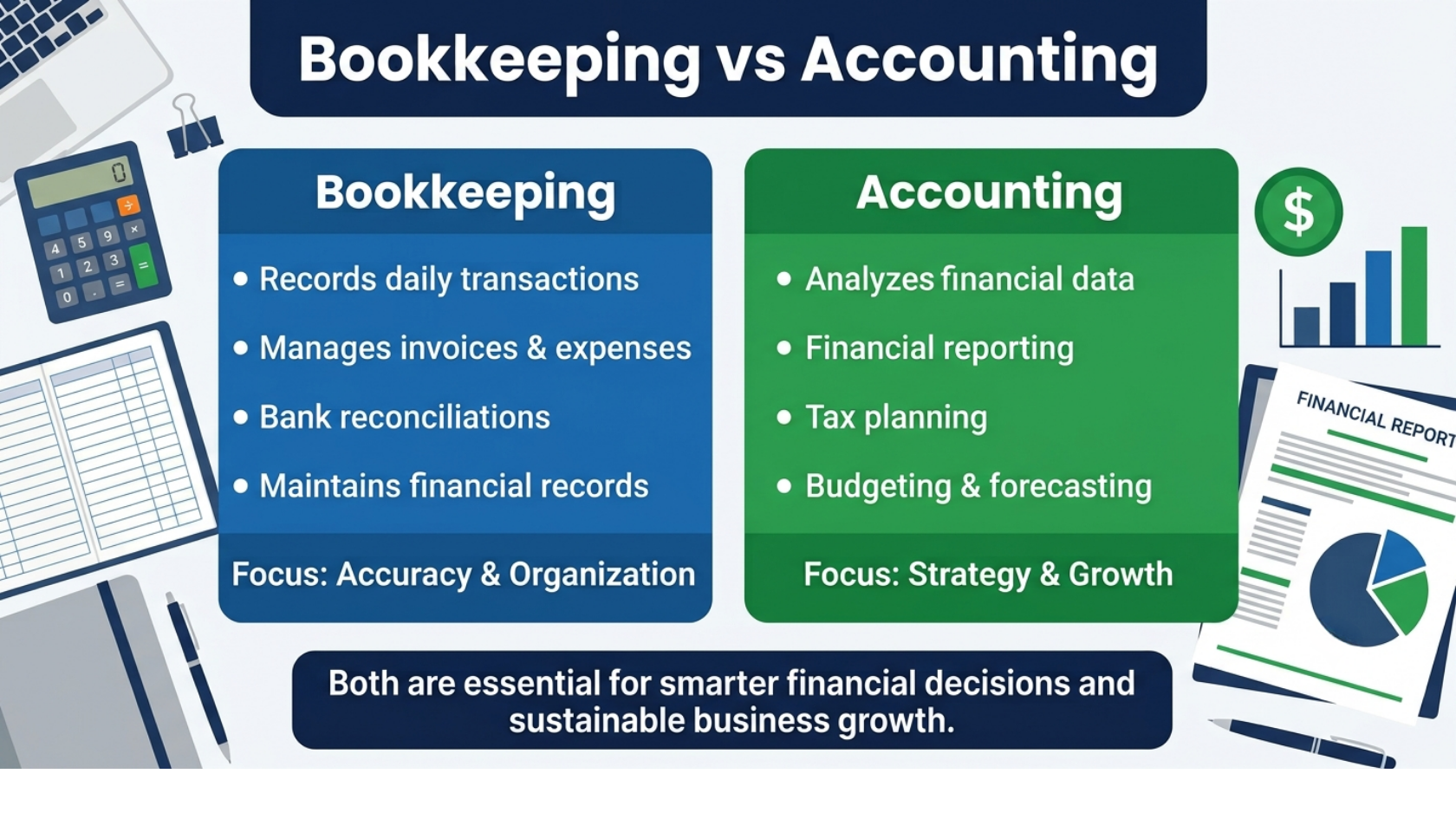
Bookkeeping is the process of recording, organizing, and maintaining your business’s daily financial transactions. It forms the foundation of your financial records and ensures that every transaction is accurately documented.
Bookkeepers are responsible for keeping financial data organized and up to date, allowing accountants to prepare reports and provide financial advice.
Common Bookkeeping Tasks
- Recording sales and income
- Tracking business expenses
- Managing invoices
- Processing accounts payable and receivable
- Reconciling bank accounts
- Recording payroll transactions
- Maintaining accurate financial records
- Organizing receipts and supporting documents
Without accurate bookkeeping, it becomes difficult to understand your business’s financial position or prepare reliable financial reports.
What Is Accounting?
Accounting is the process of analyzing, interpreting, and reporting financial information collected through bookkeeping. It focuses on transforming financial data into meaningful insights that help business owners make informed decisions.
Accountants use bookkeeping records to prepare financial statements, analyze business performance, develop tax strategies, and support long-term planning.
Common Accounting Tasks
- Preparing financial statements
- Analyzing business performance
- Preparing budgets and forecasts
- Tax planning and compliance
- Financial reporting
- Cash flow analysis
- Business advisory services
- Strategic financial planning
Accounting helps business owners understand not just where their money has gone, but how to improve profitability and achieve future growth.
Bookkeeping vs Accounting: Key Differences
| Bookkeeping | Accounting |
|---|---|
| Records daily financial transactions | Analyzes financial information |
| Focuses on accuracy and organization | Focuses on strategy and decision-making |
| Maintains financial records | Prepares financial reports |
| Handles invoices and expenses | Interprets financial data |
| Reconciles bank accounts | Creates budgets and forecasts |
| Day-to-day financial management | Long-term financial planning |
How Bookkeeping and Accounting Work Together
Think of bookkeeping as building the foundation of a house, while accounting is designing and managing the finished structure.
Bookkeeping provides clean, organized financial data.
Accounting transforms that data into valuable insights that help business owners:
- Increase profitability
- Improve cash flow
- Reduce unnecessary expenses
- Plan for growth
- Stay compliant with tax regulations
- Make informed business decisions
Without bookkeeping, accounting lacks reliable information. Without accounting, bookkeeping data remains underutilized.
Which Does Your Business Need?
The answer is simple—most businesses need both.
You primarily need bookkeeping if you:
- Are a freelancer or sole proprietor
- Need help recording daily transactions
- Want organized financial records
- Need invoice and expense management
You also need accounting if you:
- Want to understand business performance
- Need financial reports
- Plan to grow your business
- Need tax planning
- Apply for loans or investment
- Want professional financial advice
Many businesses begin with bookkeeping and gradually require more accounting services as they expand.
Benefits of Professional Bookkeeping and Accounting
Hiring professionals offers several advantages:
Better Financial Decisions
Accurate financial information helps you make smarter business choices.
Improved Cash Flow
Tracking income and expenses helps identify cash flow issues before they become serious.
Tax Compliance
Proper bookkeeping and accounting reduce errors and make tax filing much easier.
Time Savings
Outsourcing your financial management allows you to focus on running your business.
Business Growth
Reliable financial reports help identify opportunities for expansion and improved profitability.
Common Misconceptions
“Bookkeeping and Accounting Are the Same”
They are closely related but serve different purposes. Bookkeeping records financial transactions, while accounting analyzes and interprets them.
“Small Businesses Don’t Need Accounting”
Even the smallest businesses benefit from financial reporting, budgeting, and tax planning.
“Accounting Is Only for Tax Season”
Modern accounting supports decision-making throughout the year, not just during tax filing.
Signs You Need Professional Help
You should consider hiring a bookkeeping and accounting professional if:
- Your financial records are disorganized
- You spend too much time managing your books
- Cash flow is becoming difficult to manage
- Tax deadlines cause stress
- You’re growing rapidly
- You need reliable financial reports
- You’re applying for financing
Choosing the Right Bookkeeping and Accounting Partner
When selecting a provider, look for:
- Experience with businesses like yours
- Cloud accounting expertise
- Transparent pricing
- Regular financial reporting
- Strong communication
- Knowledge of leading accounting software
- Scalable services that grow with your business
Frequently Asked Questions
Can a bookkeeper prepare financial statements?
Bookkeepers maintain financial records, while accountants generally prepare and analyze formal financial statements.
Is bookkeeping easier than accounting?
Bookkeeping focuses on recording transactions, while accounting requires deeper financial analysis and strategic planning.
Can one person do both?
Yes. Many small businesses work with professionals who provide both bookkeeping and accounting services.
Which should I outsource first?
For most small businesses, outsourcing bookkeeping first creates accurate records that make accounting more effective.
Final Thoughts
Bookkeeping and accounting are two essential parts of a successful business financial system. Bookkeeping keeps your records accurate and organized, while accounting turns those records into valuable insights that drive smarter decisions and sustainable growth.
Rather than choosing between bookkeeping and accounting, businesses benefit most when both work together. Accurate bookkeeping supports reliable accounting, and professional accounting helps you understand your financial performance, improve cash flow, and plan confidently for the future.
Whether you’re launching a startup or managing an established company, investing in quality bookkeeping and accounting services is an investment in your business’s long-term success.
Related Articles
- Cash vs Accrual Accounting Explained: Which Method Is Right for Your Business?
- How to Improve Business Cash Flow: 12 Proven Strategies for Small Businesses
- Top 10 Accounting Software Tools for Small Businesses
- Small Business Accounting Made Simple: Avoid These 10 Common Mistakes
Recommended Resources
- IRS – Recordkeeping for Businesses: https://www.irs.gov/businesses/small-businesses-self-employed/recordkeeping
- IFRS Foundation: https://www.ifrs.org
- QuickBooks Resource Center: https://quickbooks.intuit.com
- Xero Learning Hub: https://www.xero.com
- SBA – Manage Your Business Finances: https://www.sba.gov/business-guide/manage-your-business/manage-your-finances