Tax season can be stressful for small business owners, especially when bookkeeping has been pushed aside during the year. Missing receipts, unreconciled bank accounts, unclear expenses, and outdated financial records can turn tax preparation into a time-consuming and expensive process.
The good news is that preparing your books for tax season does not have to be overwhelming.
With organized financial records, accurate bookkeeping, and a clear process, you can make tax preparation easier, reduce the risk of costly mistakes, and gain a clearer understanding of your business’s financial position.
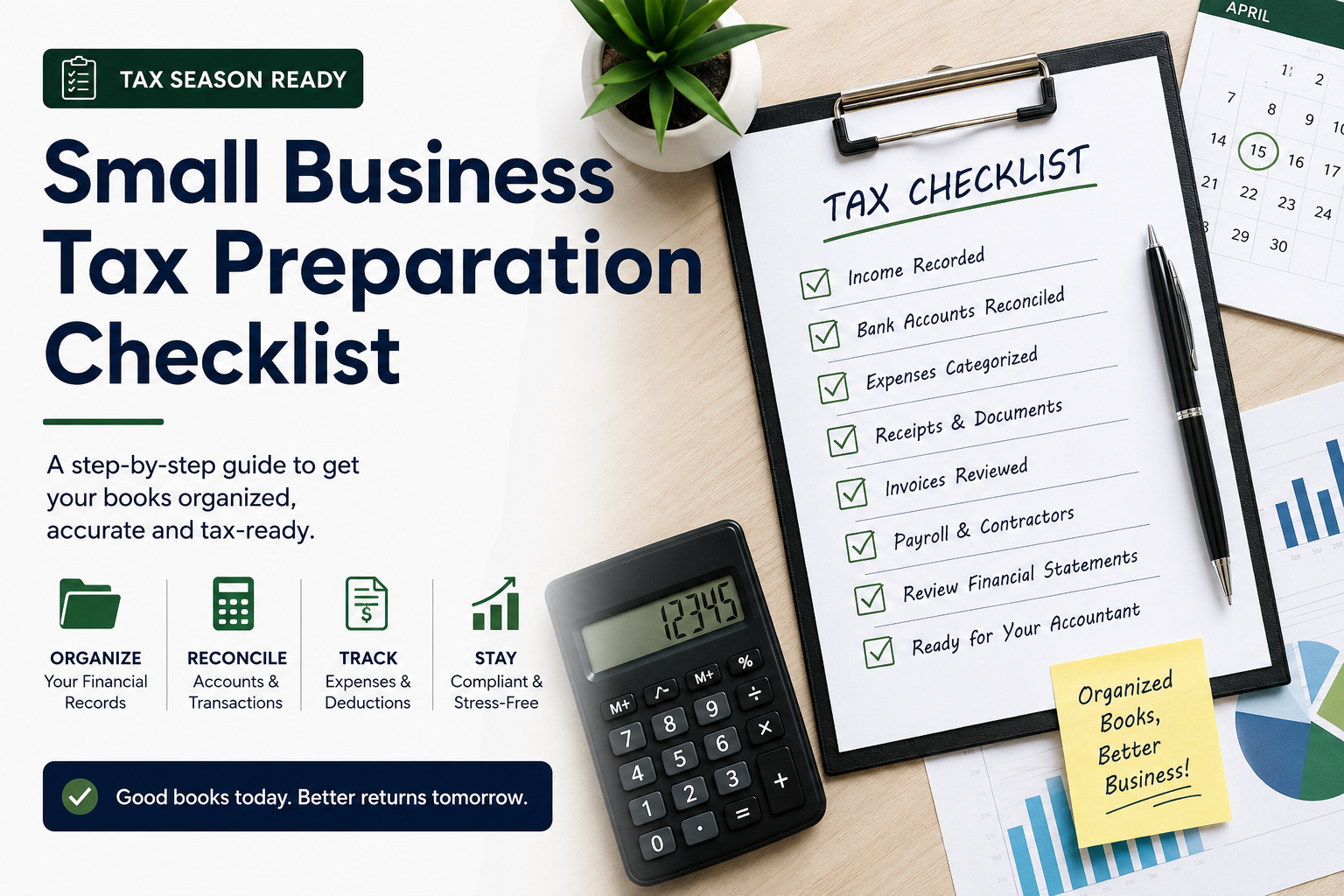
This guide provides a practical small business tax preparation checklist to help you organize your books before tax season.
Why Preparing Your Books for Tax Season Matters
Good bookkeeping is important throughout the year, but its value becomes especially clear when tax deadlines approach.
Accurate financial records can help you:
- Calculate business income and expenses accurately
- Identify deductible business expenses
- Reduce errors in tax filings
- Avoid last-minute scrambling
- Make it easier for your accountant or tax professional to prepare returns
- Maintain documentation that supports reported financial information
- Understand your business’s financial performance
Perhaps most importantly, organized books allow you to focus less on finding paperwork and more on running your business.
The Complete Small Business Tax Preparation Checklist
Use the following checklist to prepare your accounting records for tax season.
1. Make Sure All Income Has Been Recorded
The first step is ensuring that your books include all business income for the relevant accounting period.
Review income from sources such as:
- Product sales
- Client invoices
- Service revenue
- Online marketplaces
- E-commerce platforms
- Payment processors
- Bank transfers
- Other business income
Compare your accounting records with bank deposits, invoices, payment platforms, and sales reports.
If income is missing from your books, your financial statements may be inaccurate. Recording every transaction properly also helps ensure that your revenue figures are complete and consistent.
2. Reconcile All Business Bank Accounts
Bank reconciliation is one of the most important steps in preparing your books.
Reconciliation involves comparing the transactions recorded in your accounting system with transactions shown on your bank statement.
Check that:
- Every bank transaction has been recorded
- Deposits match recorded income
- Business expenses have been categorized
- Duplicate transactions have been removed
- Outstanding transactions have been reviewed
- The ending balance matches the bank statement
Unreconciled accounts can lead to incorrect income, expense, cash flow, and profit figures.
For many small businesses, monthly bank reconciliation is one of the simplest ways to prevent bookkeeping problems from building up.
3. Reconcile Credit Cards and Other Financial Accounts
Your bookkeeping should not stop with your primary bank account.
Review and reconcile:
- Business credit cards
- Savings accounts
- Payment processor accounts
- Online payment platforms
- Business loan accounts
- Other financial accounts used by the business
Every business transaction should be properly recorded.
A common bookkeeping problem occurs when expenses paid through a credit card or online payment platform are forgotten because they never appear directly on the primary business bank statement.
4. Review and Categorize Every Business Expense
Proper expense categorization is essential for accurate financial reporting and tax preparation.
Review your transactions and make sure expenses have been assigned to appropriate categories.
Depending on your business, common expense categories may include:
- Advertising and marketing
- Software and subscriptions
- Office expenses
- Professional services
- Rent and utilities
- Insurance
- Travel and business-related transportation
- Employee or contractor costs
- Inventory and supplies
Avoid leaving transactions categorized as “uncategorized,” “ask my accountant,” or similar temporary categories.
However, do not guess when you are unsure how an expense should be classified. Proper treatment can depend on the nature of the transaction and applicable tax rules.
5. Collect and Organize Receipts and Supporting Documents
Receipts and supporting documents are an important part of good financial recordkeeping.
Organize documents relating to:
- Business purchases
- Supplier invoices
- Professional services
- Travel expenses
- Equipment purchases
- Software subscriptions
- Rent and utilities
- Other significant business expenses
A simple digital filing system can make this process much easier.
Consider organizing documents by:
Year → Month → Expense Category or Vendor
For example:
2026 → March → Software → Accounting Software Invoice
The goal is to make important documents easy to locate when needed.
6. Review Outstanding Customer Invoices
If your business invoices customers, review your accounts receivable before closing your books for the period.
Identify:
- Unpaid invoices
- Overdue customer balances
- Payments that have been received but not recorded
- Duplicate invoices
- Credit notes or adjustments
Following up on outstanding invoices can improve cash flow while ensuring that your accounting records accurately reflect money owed to the business.
Your accounts receivable balance should be reviewed regularly rather than only at tax time.
7. Review Unpaid Bills and Business Liabilities
Just as you review money owed to your business, review money your business owes to others.
This may include:
- Supplier bills
- Contractor payments
- Credit card balances
- Business loans
- Other outstanding obligations
Depending on the accounting method used by your business, unpaid expenses may need to be recorded in the appropriate accounting period.
Accurate liability records help ensure that your balance sheet presents a clearer picture of your financial position.
8. Review Payroll and Contractor Payments
If you have employees or work with independent contractors, review the relevant payment records before tax season.
Check that:
- Employee payments have been recorded
- Contractor payments have been recorded
- Payroll records are complete
- Relevant payroll liabilities have been reviewed
- Required payment documentation is organized
Payroll mistakes can create significant administrative problems, so this area deserves careful attention.
If your business uses a payroll provider, compare payroll reports with the amounts recorded in your accounting system.
9. Review Your Inventory Records
For product-based and e-commerce businesses, inventory can significantly affect financial reporting.
Review:
- Opening inventory
- Inventory purchases
- Cost of goods sold
- Damaged or obsolete inventory
- Ending inventory
Your accounting records should be consistent with your inventory records and sales activity.
Businesses selling through multiple channels should also ensure that inventory and sales information from e-commerce platforms is properly reflected in their books.
10. Review Large Purchases and Fixed Assets
Not every business purchase is treated the same way in the accounts.
Large purchases such as equipment, computers, machinery, furniture, or other long-term business assets may require different accounting treatment from ordinary operating expenses.
Create a list of significant purchases made during the year and include:
- Date of purchase
- Description of the asset
- Amount paid
- Supporting documentation
A professional accountant can help determine the appropriate accounting and tax treatment based on the relevant rules and your specific circumstances.
11. Check Your Loan and Financing Accounts
Review all business debt and financing arrangements.
This may include:
- Bank loans
- Business loans
- Equipment financing
- Credit facilities
- Owner financing
Make sure the balances in your accounting system agree with relevant statements and records.
Also review whether payments have been correctly separated between the appropriate components where necessary.
Accurate loan records are essential for producing a reliable balance sheet.
12. Review Owner Transactions
For sole proprietors, partnerships, and other owner-managed businesses, personal and business transactions can sometimes become mixed together.
Review transactions involving:
- Owner contributions
- Owner withdrawals
- Personal expenses paid by the business
- Business expenses paid personally by the owner
Keeping personal and business finances separate can simplify bookkeeping and improve the accuracy of financial reporting.
If personal and business transactions have been mixed, identify and classify them correctly before finalizing your books.
13. Run and Review Your Financial Statements
Once your transactions have been recorded and reconciled, generate your key financial reports.
At minimum, review:
Profit and Loss Statement
Your profit and loss statement shows:
- Revenue
- Expenses
- Gross profit
- Operating costs
- Net profit or loss
Review the report for unusual changes, duplicate expenses, missing income, or unexpected balances.
Balance Sheet
Your balance sheet provides a snapshot of:
- Assets
- Liabilities
- Owner’s equity
Check for unusual account balances or transactions that require further investigation.
Cash Flow Information
Reviewing cash movement can help you understand:
- Where cash came from
- Where cash was spent
- Whether the business is generating sufficient operating cash
Financial statements should not simply be generated and ignored. Reviewing them can help identify bookkeeping errors before tax information is finalized.
14. Investigate Unusual or Unexpected Transactions
Before closing your books, look for transactions that appear unusual.
Examples include:
- Duplicate expenses
- Unexpectedly large transactions
- Negative account balances
- Uncategorized transactions
- Missing invoices
- Unexplained transfers
- Expenses recorded in the wrong category
A small error may seem insignificant individually, but multiple errors can materially affect your financial reports.
15. Create a Tax-Ready Financial Package
Once your books are organized, prepare a clear set of financial records for your accountant or tax professional.
Your package may include:
- Profit and loss statement
- Balance sheet
- Bank and credit card statements
- Accounts receivable information
- Accounts payable information
- Payroll records
- Contractor payment records
- Loan statements
- Asset purchase information
- Relevant receipts and supporting documents
Having these records organized can make the tax preparation process significantly smoother.
Common Small Business Bookkeeping Mistakes to Avoid Before Tax Season
Preparing your books is also an opportunity to identify common mistakes.
Waiting Until the Last Minute
Trying to organize an entire year’s worth of transactions immediately before a deadline can increase the risk of errors.
Regular monthly bookkeeping is usually far easier than a large year-end cleanup.
Mixing Personal and Business Expenses
Combining personal and business spending can make bookkeeping unnecessarily complicated.
Separate accounts and payment methods can make transactions easier to identify and track.
Ignoring Small Transactions
Small expenses can accumulate over time. Recording transactions consistently helps ensure that your financial records are complete.
Failing to Reconcile Accounts
Without reconciliation, errors can remain hidden in your books for months.
Relying Only on Your Bank Balance
Your bank balance does not show the complete financial health of your business.
A business may have cash in the bank while still owing suppliers, carrying debt, or waiting to receive payment from customers.
That is why accurate financial statements are essential.
How Often Should Small Businesses Update Their Books?
The best approach is to maintain your books throughout the year.
For many small businesses, a monthly bookkeeping routine may include:
- Recording income and expenses
- Reconciling bank and credit card accounts
- Reviewing outstanding invoices
- Reviewing unpaid bills
- Organizing receipts and documents
- Reviewing financial reports
Businesses with a high volume of transactions may require more frequent bookkeeping.
Consistent bookkeeping reduces the amount of work required at year-end and gives business owners access to more reliable financial information throughout the year.
Should You Hire a Professional Bookkeeper Before Tax Season?
If your books are significantly behind, inaccurate, or difficult to understand, professional bookkeeping support can be valuable.
A bookkeeper can help:
- Organize historical transactions
- Reconcile financial accounts
- Categorize income and expenses
- Clean up bookkeeping records
- Prepare accurate financial reports
- Maintain books on an ongoing basis
Your tax professional can then work with better-organized financial information.
For growing businesses, outsourcing bookkeeping can also free up time that would otherwise be spent managing spreadsheets, receipts, invoices, and accounting software.
Final Thoughts
Tax season should not be the first time you discover the true state of your business finances.
By keeping your books organized, reconciling accounts regularly, reviewing financial statements, and maintaining supporting documentation, you can make tax preparation easier and gain a clearer understanding of your business throughout the year.
The best strategy is not simply to prepare your books when tax season arrives.
It is to maintain accurate, up-to-date financial records all year long.
If your bookkeeping is behind or your financial records need attention, professional bookkeeping and accounting support can help you organize your books, improve financial visibility, and spend more time focusing on your business.
Need Help Getting Your Books Tax-Ready?
If you need help organizing your business transactions, reconciling accounts, cleaning up outdated books, or maintaining accurate financial records throughout the year, professional bookkeeping support can make the process easier.
Contact Fintocrat to discuss your bookkeeping and accounting needs and get your business finances organized.
More Articles
- Case Study: From Scattered Finances to a Smarter, Growth-Ready Business
- Can AI Predict Start-up Failure? A Data-Driven Financial Study
- The Network Effect Explained: How Businesses Become More Valuable as They Grow
- Cash vs Accrual Accounting Explained: Which Method Is Right for Your Business?
- How to Improve Business Cash Flow: Proven Strategies for Sustainable Growth